İngilizce
We reached the place by night, And heard the waves breaking: They came to meet us with candles alight To show the path we were taking.…
Aramak için en az iki harf yaz.
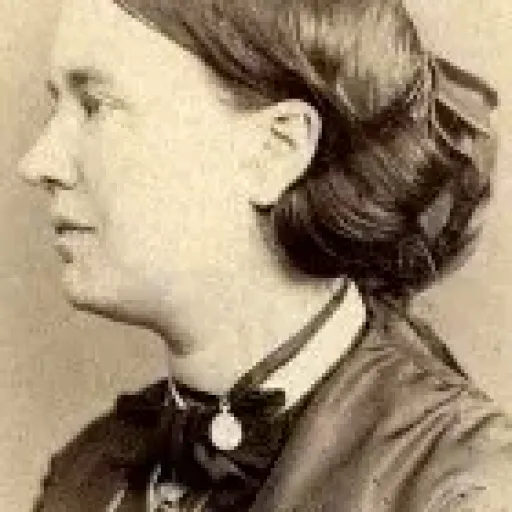
Jean Ingelow was an English poet and novelist. Early Life and Education Born at Boston, Lincolnshire, she was the daughter of William Ingelow, a banker. As a girl she contributed verses and tales to magazines under the pseudonym of Orris, but her first (anonymous) volume, A Rhyming Chronicle of Incidents and Feelings, did not appear until her thirtieth year. This was called charming by Tennyson, who declared he should like to know the author; they later became friends. Writings Jean Ingelow followed this book of verse in 1851 with a story, Allerton and Dreux, but it was the publication of her Poems in 1863 which suddenly made her a popular writer. They ran rapidly through numerous editions and were set to music, proving very popular for English domestic entertainment. In the United States, her poems obtained great public acclaim. In 1867 she published The Story of Doom and other Poems, and then gave up verse for a while and became industrious as a novelist. Off the Skelligs appeared in 1872, Fated to be Free in 1873, Sarah de Berenger in 1880, and John Jerome in 1886. She also wrote Studies for Stories (1864), Stories told to a Child (1865), Mopsa the Fairy (1869), and other stories for children. Mopsa the Fairy, about a boy who discovers a nest of fairies and discovers a fairyland while riding on the back of a pelican) was one of her most popular works (it was reprinted in 1927 with illustrations by Dorothy Lathrop). Anne Thaxter Eaton, writing in A Critical History of Children's Literature, calls the book "a well-constructed tale", with "charm and a kind of logical make-believe."[1] Her third series of Poems was published in 1885. The last years of her life were spent in Kensington, and she outlived her popularity as a poet. Collected poems Her poems, collected in one volume in 1898, have often the genuine ballad note, and her songs were exceedingly successful. Sailing beyond Seas and When Sparrows build in Supper at the Mill were among the most popular songs of the day; but they share, with the rest of her work, the faults of affectation and stilted phraseology. Her best-known poem was High Tide on the Coast of Lincolnshire. The blemishes of her style were cleverly indicated in a well-known parody (Lovers, and a Reflexion) by Charles Stuart Calverley; a false archaism and a deliberate assumption of unfamiliar and unnecessary synonyms for simple objects were among the worst of her mannerisms. Postmodern novelist Gilbert Sorrentino, in his satirical novel Blue Pastoral (1983), lampooned her Supper at the Mill, a poem cast in the form of a dramatic vignette, as "Supper at the Kind Brown Mill." She wrote, however, with a sweetness of sentiment, and in prose she displayed feeling for character and the gift of narrative; a delicate underlying tenderness is never wanting in either medium. She was a woman of frank and hospitable manners, with a look of the Lady Bountiful of a country parish. She had nothing of the professional authoress or the literary lady about her, and, as with characteristic simplicity she was accustomed to say, was no great reader. Her temperament was rather that of the improvisatore than of the professional author or artist. Ingelow died in 1897 and is buried in Brompton Cemetery, London.)
We reached the place by night, And heard the waves breaking: They came to meet us with candles alight To show the path we were taking.…
I took a year out of my life and story— A dead year, and said, 'I will hew thee a tomb! 'All the kings of the nations lie in glory;' Cased in cedar, and shut in a sacred gloom;…
(THE PARSON’S BROTHER, SISTER, AND TWO CHILDREN) Preface. What wonder man should fail to stay…
Living child or pictured cherub Ne'er o'ermatched its baby grace; And the mother, moving nearer, Looked it calmly in the face;…
Haply some Rajah first in ages gone Amid his languid ladies finger'd thee, While a black nightingale, sun-swart as he, Sang his one wife, love's passionate orison:…
They said 'Too late, too late, the work is done; Great Homer sang of glory and strong men And that fair Greek whose fault all these long years…
Old Albion sat on a crag of late, And sung out—'Ahoy! ahoy! Long life to the captain, good luck to the mate, And this to my sailor boy!…
1. The white broom flatt'ring her flowers in calm June weather, 'O most sweet wear;…
Niloiya said to Noah, 'What aileth thee, My master, unto whom is my desire, The father of my sons?' He answered her, 'Mother of many children, I have heard…
Now ere the sunrise, while the morning star Hung yet behind the pine bough, woke and prayed The world's great shipwright, and his soul was glad Because the Voice was favorable. Now…
Above the head of great Methuselah There lay two demons in the opened roof Invisible, and gathered up his words; For when the Elder prophesied, it came…
Now while these evil ones took counsel strange, The son of Lamech journeyed home; and, lo! A company came down, and struck the track As he did enter it. There rode in front…
The prayer of Noah. The man went forth by night And listened; and the earth was dark and still, And he was driven of his great distress Into the forest; but the birds of night…
And when two days were over, Japhet said, 'Mother, so please you, get a wife for me.' The mother answered, 'Dost thou mock me, son? 'Tis not the manner of our kin to wed…
Night. Now a tent was pitched, and Japhet sat In the door and watched, for on a litter lay The father of his love. And he was sick To death; but daily he would rouse him up,…
15 / 91 gösteriliyor
Sana daha iyi bir okuma deneyimi sunabilmek için sitemizde çerez kullanıyoruz. Kişisel verilerin KVKK ve GDPR kapsamında işlenir; hangi çerezlere izin verdiğini dilediğin zaman değiştirebilirsin.