The Mutiny Of The Chains
J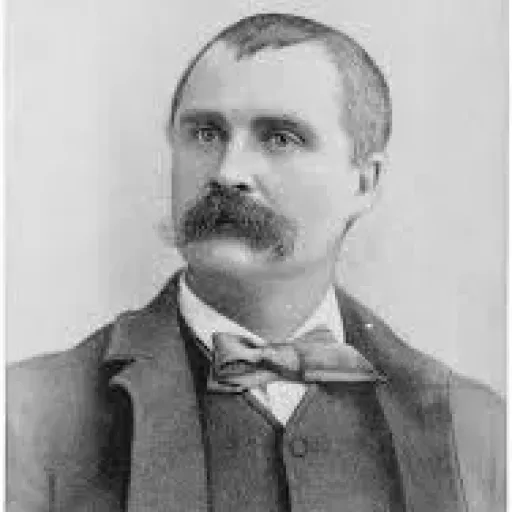 John Boyle O’Reilly
0
Altın Yaprak
PENAL COLONY OF WESTERN AUSTRALIA, 1857
THE sun rose o'er dark Fremantle,
And the Sentry stood on the wall;
Above him, with white lines swinging,
The flag-staff, bare and tall:
The flag at its foot—the Mutiny Flag—
Was always fast to the line,—
For its sanguine field was a cry of fear,
And the Colony counted an hour a year
In the need of the blood-red sign.
The staff and the line, with its ruddy flash,
lake a threat or an evil-bode,
Were a monstrous whip with a crimson lash,
Fit sign for the penal code.
The Sentry leant on his rifle, and stood
By the mast, with a deep-drawn breath;
A stern-browed man, but there heaved a sigh
For the sight that greeted his downward eye
In the prison-square beneath.
In yellow garb, in soldier lines,
One hundred men in chains;
While the watchful warders, sword in hand,
With eyes suspicious keenly scanned
The links of the living lanes.
There, wary eyes met stony eyes,
And stony face met stone.
There was never a gleam of trust or truce;
In the covert thought of an iron loose,
Grim warder and ward were one.
Why was it so, that there they stood,—
Stern driver and branded slave?
Why rusted the gyve in the bondman's blood,
No hope for him but the grave?
Out of thousands there why was it so
That one hundred hearts must feel
The bitterest pang of the penal woe,
And the grind of a nation's heel?
Why, but for choice—the bondman's choice?
They balanced the gains and pains;.
They took their chance of the chains.
There spake in their hearts a hidden voice
Of the blinding joy of a freeman's burst
Through the great dim woods. Then the toil accurst;
The scorching days and the nights in tears
The riveted rings for years and years;
They weighed them all—they looked before
At the one and other, and spoke them o'er,
And they saw what the heart of man must see,
That the uttermost blessing is Liberty!
Ah, pity them, God! they must always choose,
For the life to gain and the death to lose.
They dream of the woods and the mountain spring,
And they grasp the flower, to clutch the sting.
Even so: they are better than those who bend
Like beasts to the lash, and go on to the end
As a beast will go, with to-day for a life,
And to-morrow a blank. Offer peace and strife
To a man enslaved—let him vote for ease
And coward labor, and be content;
Or let him go out in the front, as these,
With their eyes on the doom and the danger, went.
And take your choice—the man who remains
A self-willed serf, or the one who stains
His sudden hand with a drive for light
Through a bristling rank and a gloomy night.
This man for me—for his heart he'll share
With a friend: with a foe, he'll fight him fair.
And such as he are in every rank
Of the column that moves with a dismal clank
And a dead-march step toward the rock-bound place
Where the chain-gangs toil—o'er the beetling face
Of the cliff that roots in the Swan's deep tide:
Steep walls of granite on either side,
At the precipice' foot the river wide;
Behind them in ranks the warders fall;
And above them, the Sentry paces the wall.
Year in, year out, has the Sentry stood
On the wall at the foot of the mast.
He has turned from the toilers to watch the flood
Like, his own slow life go past.
He has noted the Chains grow fat and lean;
He has sighed for their empty spaces,
And thought of the cells where their end had been,
Where they lay with their poor dead faces,
With never a kiss, or prayer, or knell—
They were better at rest in the river;
He thinks of the shadow that o'er them fell
From the mast with its whip-like quiver;
He has seen it tipped with its crimson lash
When the mutiny-flood had risen
And swept like a sea with an awful swash
Through the squares and the vaulted prison.
His thoughts are afar with the woeful day,
With the ranged dead men and the dying,
And slowly he treads till they pass away—
Then a pause, and a start, and a scuffling sound,
And a glance beneath, at a battle-ground,
Where the lines are drawn, and the Chains are found
Their armed guards defying!
A hush of death—and the Sentry stands
By the mast, with the halyards tight in his hands,
And the Mutiny Flag is flying!
Woe to the weak, to the mutineers!
The bolt of their death is driven;
A mercy waits on all other tears,
But the Chains are never forgiven.
Woe to the rebels!—their hands are bare,
Their manacled bodies helpless there;
Their faces lit with a strange wild light,
As if they had fought and had won the fight!
No cry is uttered—upraised no hand;
All stilled to a muscle's quiver;
One line on the brink of the cliff they stand,
Their shadows flung down on the river.
The quarry wall is on either side,
The blood-red flag high o'er them;
But the lurid light in their eyes defied
The gathering guards before them.
No parley is held when the Chains revolt:
Grimly silent they stand secure
On the outward lip of the embrasure;
Waiting fierce-eyed for the fatal bolt.
A voice from the guard, in a monotone;
A voice that was cold and hard as stone: —
'Make ready! Fire!'
O Christ, the cry
From the manacled men! not fear to die,
Or whine for mercy; rebelled they stood,
Well knowing the price of revolt was blood;
Well knowing—but each one knew that he
Would sell his blood for his liberty!
Unwarned by a word, uncalled, unshriven,
They dare by a look—and the doom is given.
They raise their brows in the wild revolt,
And God's wrath flames in the fierce death-bolt;
God's wrath?—nay, man's; God never smote
A rebel dead whose swelling throat
Was full with protest. Hear, then smite;
God's justice weighs not shrieks the right.
'Make ready! Fire!'
Again outburst
The horror and shame for the deed accurst!
O, cry of the weak, as the hot blood calls
From the burning wound, and the stricken falls
With his face in the dust; and the strong one stands,
With scornful lips and ensanguined hands;
O, blood of the weak, unbought, unpriced,
Thy smoke is a piteous prayer to Christ!
They stand on the brink of the cliff—they bend
To the dead in their chains; then rise, and send
To the murdering muzzles defiant eyes.
'Make ready! Fire!'
The smoke-clouds rise:
They are still on the face of the cliff—they bend
Once more to the dead—they whisper a word
To the hearts in the dust—then, undeterred,
They raise their, faces, so grimly set,
Till the eyes of slayer and doomed have met.
O merciful God, let thy pity rain
Ere the hideous lightning leaps again!
They have sinned—they have erred—let the living stand
They have dared and rued—let thy loving hand
Be laid on those brows that bravely face
The death that shall wash them of all disgrace!
Be swift with pity—O, late, too late!
The tubes are leveled—the marksmen wait
For the word of doom—the spring is pressed
By the nervous finger—the sight is straight—
'Make ready!'—
Why falters the dread command?
Why stare as affrighted the armed band?
Why lower the rifles from shoulder to hip.
Why dies the word on the leader's lip,
While the voice that was hard grows husky deep
And the face is a-tremble as if to weep?
The Chains on the brink of the cliff are lined;
The living are bowed o'er the dead—they rise
And they face the rifles with burning eyes;
Then they bend again, and with one set mind
They raise the dead and the wounded raise
In their loving arms with words of praise
And tender grief for the torturing wounds.
One backward step with a burdened tread—
They bear toward the-precipice wounded and dead—
Then they turned on the cliff to front the guard
With faces like men that have died in fight;
Their brows were raised as if proud reward
Were theirs, and their eyes had a victor's light.
They spoke not a word, but stood sublime
In their somber strength, and the watchers saw
That they smiled as they looked, and their words were heard
As they spoke to the dying a loving word.
They were Men at last—they knew naught of crime;
They were masters and makers of life and law.
They turned from the guard that quailed and shrank
From the gleaming eyes of the burdened rank;
They turned on the cliff, and a sob was heard
As they looked far down on the darkened river;
They raised their eyes to the sky—they grasped
The dead to their breasts, while the wounded clasped
The necks of the brothers who bore their weight—
Then they sprang from the cliff, as a horse will spring
For his life from a precipice—sprang to death
In silence and sternness—one deep breath,
As they plunged, of liberty, thrilled their souls,
And then—the Chains were at rest forever!
Kamu malı: şairin ölümünün üzerinden 70 yıldan fazla geçti.
Bu şiiri puanla
Henüz puan verilmemiş