Grass From The Battle-Field
S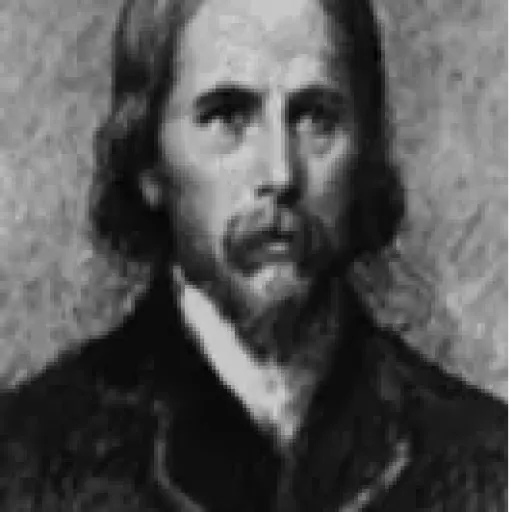 Sydney Thompson Dobell
0
Altın Yaprak
Small sheaf
Of withered grass, that hast not yet revealed
Thy story, lo! I see thee once more green
And growing on the battle-field,
On that last day that ever thou didst grow!
I look down thro' thy blades and see between
A little lifted clover leaf
Stand like a cresset: and I know
If this were morn there should be seen
In its chalice such a gem
As decks no mortal diadem
Poised with a lapidary skill
Which merely living doth fulfil
And pass the exquisite strain of subtlest human will.
But in the sun it lifteth up
A dry unjewelled cup,
Therefore I see that day doth not begin;
And yet I know its beaming lord
Hath not yet passed the hill of noon,
Or thy lush blades
Would be more dry and thin,
And every blade a thirsty sword
Edged with the sharp desire that soon
Should draw the silver blood of all the shades.
I feel 't is summer. This whereon I stand
Is not a hill, nor, as I think, a vale;
The soil is soft upon the generous land,
Yet not as where the meeting streams take hand
Under the mossy mantle of the dale.
Such grass is for the meadow. If I try
To lift my heavy eyelids, as in dreams
A power is on them, and I know not why.
Thou art but part; the whole is unconfest:
Beholding thee I long to know the rest.
As one expands the bosom with a sigh,
I stretch my sight's horizon; but it seems,
Ere it can widen round the mystery,
To close in swift contraction, like the breast.
The air is held, as by a charm,
In an enforcèd silence, as like sound
As the dead man the living. 'T is so still,
I listen for it loud.
And when I force my eyes from thy sole place
And see a wider space,
Above, around,
In ragged glory like a torn
And golden-natured cloud,
O'er the dim field a living smoke is warm;
As in a city on a sabbath morn
The hot and summer sunshine goes abroad
Swathed in the murky air,
As if a god
Enrobed himself in common flesh and blood,
Our heavy flesh and blood,
And here and there
As unaware
Thro' the dull lagging limbs of mortal make,
That keep unequal time, the swifter essence brake.
But hark a bugle horn!
And, ere it ceases, such a shock
As if the plain were iron, and thereon
An iron hammer, heavy as a hill,
Swung by a monstrous force, in stroke came down
And deafened Heaven. I feel a swound
Of every sense bestunned.
The rent ground seems to rock,
And all the definite vision, in such wise
As a dead giant borne on a swift river,
Seems sliding off for ever,
When my reviving eyes,
As one that holds a spirit by his eye
With set inexorable stare,
Fix thee: and so I catch, as by the hair,
The form of that great dream that else had drifted by.
I know not what that form may be;
The lock I hold is all I see,
And thou, small sheaf! art all the battle-field to me.
The wounded silence hath not time to heal
When see! upon thy sod
The round stroke of a charger's heel
With echoing thunder shod!
As the night-lightning shows
A mole upon a momentary face,
So, as that gnarled hoof strikes the indented place,
I see it, and it goes!
And I hear the squadrons trot thro' the heavy shell and shot,
And wheugh! but the grass is gory!
Forward ho! blow to blow, at the foe in they go,
And 'tis hieover heigho for glory!
The rushing storm is past,
But hark! upon its track the far drums beat,
And all the earth that at thy roots thou hast
Stirs, shakes, shocks, sounds, with quick strong tramp of feet
In time unlike the last.
Footing to tap of drum
The charging columns come;
And as they come their mighty martial sound
Blows on before them as a flaming fire
Blows in the wind; for, as old Mars in ire
Strode o'er the world encompassed in a cloud,
So the swift legion, o'er the quaking ground,
Strode in a noise of battle. Nigh and nigher
I heard it, like the long swell gathering loud
What-time a land-wind blowing from the main
Blows to the burst of fury and is o'er,
As if an ocean on one fatal shore
Fell in a moment whole, and threw its roar
Whole to the further sea: and as the strain
Of my strong sense cracked in the deafened ear,
And all the rushing tumult of the plain
Topped its great arch above me, a swift foot
Was struck between thy blades to the struck root,
And lifted: as into a sheath
A sudden sword is thrust and drawn again
Ere one can gasp a breath.
I was so near,
I saw the wrinkles of the leather grain,
The very cobbler's stitches, and the wear
By which I knew the wearer trod not straight;
An honest shoe it seemed that had been good
To mete the miles of any country lane,
Nor did one sign explain
'T was made to wade thro' blood.
My shoe, soft footstooled on this hearth, so far
From strife, hath such a patch, and as he past
His broken shoelace whipt his eager haste.
An honest shoe, good faith! that might have stood
Upon the threshold of a village inn
And welcomed all the world: or by the byre
And barn gone peaceful till the day closed in,
And, scraped at eve upon some homely gate,
Ah, Heaven! might sit beside a cottage fire
And touch the lazy log to softer flames than war.
Long, long, thou wert alone,
I thought thy days were done,
Flat as ignoble grass that lies out mown
By peaceful hands in June, I saw thee lie.
A worm crawled o'er thee, and the gossamer
That telegraphs Queen Mab to Oberon,
Lengthening his living message, passed thee by.
But rain fell: and thy strawed blades one by one
Began to stir and stir.
And as some moorland bird
Whom the still hunter's stalking steps have stirred,
When he stands mute, and nothing more is heard,
With slow succession and reluctant art
Grows upward from her bed,
Each move a muffled start,
And thro' the silent autumn covert red
Uplifts a throbbing head
That times the ambushed hunter's thudding heart;
Or as a snow-drop bending low
Beneath a flake of other snow
Thaws to its height when spring winds melt the skies,
And drip by drip doth mete a measured rise;
Or as the eyelids of a child's fair eyes
Lift from her lower lashes slow and pale
To arch the wonder of a fairy tale;
So thro' the western light
I saw thee slowly rearing to thy height.
Then when thou hadst regained thy state,
And while a meadow-spider with three lines
Enschemed thy three tall pillars green,
And made the enchanted air between
Mortal with shining signs,
(For the loud carrion-flies were many and late),
Betwixt thy blades and stems
There fell a hand,
Soft, small and white, and ringed with gold and gems;
And on those stones of price
I saw a proud device,
And words I could not understand.
Idly, one by one,
The knots of anguish came undone,
The fingers stretched as from a cramp of woe,
And sweet and slow
Moved to gracious shapes of rest,
Like a curl of soft pale hair
Drying in the sun.
And then they spread,
And sought a wonted greeting in the air,
And strayed
Between thy blades, and with each blade
As with meeting fingers played
And tresses long and fair.
Then again at placid length it lay,
Stretched as to kisses of accustomed lips;
And again in sudden strain
Sprang, falling clenched with pain,
Till the knuckles white,
Thro' the evening gray,
Whitened and whitened as the snowy tips
Of far hills glimmer thro' the night.
But who shall tell that agony
That beat thee, beat thee into bloody clay
Red as the sards and rubies of the rings;
As when a bird, fast by the fowler's net,
A moment doth forget
His fetters, and with desperate wings
A-sudden springs and falls,
And (while from happy clouds the skylark calls)
Still feebler springs
And fainter falls,
And still untamed upon the gory ground
With failing strength renews his deadly wound?
At length the struggle ceased; and my fixed eye
Perceived that every finger wan
Did quiver like the quivering fan
Of a dying butterfly,
Nor long I watched until
Even the humming in the air was still.
Then I gazed and gazed,
Nor once my aching eyeballs raised
Till a poor bird that had a meadow nest
Came down, and like a shadow ran
Among the shadowy grass.
I followed with mine eyes; and with a strain
Pursued her, till six cubits' length beyond
Thy central sheaf, I found
A sight I could not pass.
The hacked and haggard head
Of a huge war-horse dead.
The evening haze hung o'er him like a breath,
And still in death
He stretched drawn lips of rage that grinned in vain;
A sparrow chirped upon
His wound, and in his dying slaver fed,
Or picked those teeth of stone
That bit with lifeless jaws the purple tongue of pain.
But I remembered that dead hand
I left to trace the childless lark,
And back o'er those six cubits of grass-land,
Blade by blade, and stalk by stalk,
As one doth walk
Who, mindful, counts by dark
Along the garden palings to the gate,
I felt along the vision to where late
There lay that dead hand white;
But now methought that there was something more
Than when I looked before,
And what was more was sweeter than the rest;
As when upon the moony half of night
Aurora lays a living light,
Softer than moonshine, yet more bright.
And as I looked I was aware
Another hand was on the hand,
A smaller hand, more fair
But not more white, as is the warm delight
That curves and curls and coyly glows
About the blushing heart of the white rose
More fair but not more white
Than those broad beauties that expand
And fall, and falling blanch the morning air.
Both hands lay motionless,
The living on the dead. But by and by
The living hand began to move and press
The cold dead flesh, and took its silent way
So often o'er the unrespective clay,
In such long-drawn caress
Of pleading passion, such an ecstacy
Of supplicating touch, that as they lay
So like, so unlike, twined with the fond art
And all the dear delay
And dreadful patience of a desperate heart,
Methought that to the tenement
From which it lately went,
The naked life had come back, and did try
By every gate to enter. While I thought,
With sudden clutch of new intent
The living grasp had caught
The dead compliance. Slowly thro'
The dusky air she raised it, and aloft,
While all her fingers soft
And every starting vein
Tightened as in a rack of pain,
Held it one straining moment fixed and mute,
And let it go.
And with a thud upon the sod,
It fell like falling fruit.
Then there came a cry,
Tearless, bloodless, dry
Of every sap of sorrow but its own-
It had no likeness among living cries;
And to my heart my streaming blood was blown
As if before my eyes
A dead man sprang up dead, and dead fell down.
The carrion-hunting winds that prowl the wold,
Frenzied for prey, sweep in and bear it on,
Far, far and further thro' the shrieking cold,
And still the yelling pack devour it as they run.
And silence, like a want of air,
Was round me, and my sense burned low,
And darkness darkened; and the glow
Of the living hand being gone,
The dead hand showed like a pale stone
Full fathom five
Under a quiet bay.
But still my sight did dive
To reach it where it lay,
And still the night grew dark, and by degrees
The dead thing glimmered with a drownèd light,
As faces seem and sink in depths of darkening seas.
Then, while yet
My set eyes saw it, as the sage doth set
His glass to some dim glimpse afar
That palpitates from mote to star,
It was touched and hid;
Touched and hid, as when a deep sea-weed
Hides some white sea-sorrow. All
My sight uprose, and all my soul
(As one who presses at the pane
When a city show goes by),
Crowded into the fixed eye,
And filled the starting ball.
Nor filled in vain.
I began to feel
The air had something to reveal.
Beyond the blank indifference
Was underlined another sense,
Was rained a gracious influence;
And tho' the darkness was so deep,
I knew it was not wholly dead,
Nor empty, as we feel in sleep
That some one standeth by the bed.
I beheld, as who should look
In trance upon a sealèd book.
I perceived that in a place
The night was lighter, as the face
Of an Indian Queen when love
Draws back the dark blood from her sick
Pale cheek
Behind the sable curtain that doth not move.
No outer light was shed,
But as the mystery
Before my stronger will did slowly yield,
I saw, as in that dark hour before morn
When the shocks of harvest corn
Exhale about the midnight field
The wealth of yellow suns, and breathe a gentle day.
I saw the shape of a fair bended head,
And hair pale streaming long and low
Veiling the face I might not know,
And dabbling all the ground with sweet uncertain woe.
Much I questioned in my mind
Of her form and kind,
But my stern compelling eye
Brought no other answer from the air,
Nor did my rude hand dare
Profane that agony.
I watched apart
With such a sweet awe in my heart
As looks up dumb into the sky
When that goddess, lorn and lone,
Who slew grim winter like a polar bear,
And threw his immemorial white
Upon her granite throne,
Sits all unseen as Death,
Save for the loss of many a hidden star
And for the wintry mystery of her breath,
And at a far-sight that she sees,
Bowed by her great despair,
Bendeth her awful head upon her knees,
And all her wondrous hair
Dishevels golden down the northern night.
At length my weary gaze
Rents: and, haze in haze
Pervolving as in glad release,
I saw each separate shade
Slide from his place and fade,
And all the flowering dark did winter back
Into its undistinguished black.
So the sculptor doth in fancy make
His formèd image in the formless stone,
And while his spells compel,
Can see it there full well,
The ivory kernel in the ivory shell,
But shakes himself and all the god is gone.
Alas!
And have I seen thee but an hour?
And shalt thou never tell
Thy story, oh thou broken flower,
Thou midnight asphodel
Among the battle grass?
Too soon! too soon!
But while I bid thee stay,
Night, like a cloud, dissolves into the day,
And from the city clock I hear the stroke of noon.
Kamu malı: şairin ölümünün üzerinden 70 yıldan fazla geçti.
Bu şiiri puanla
Henüz puan verilmemiş